
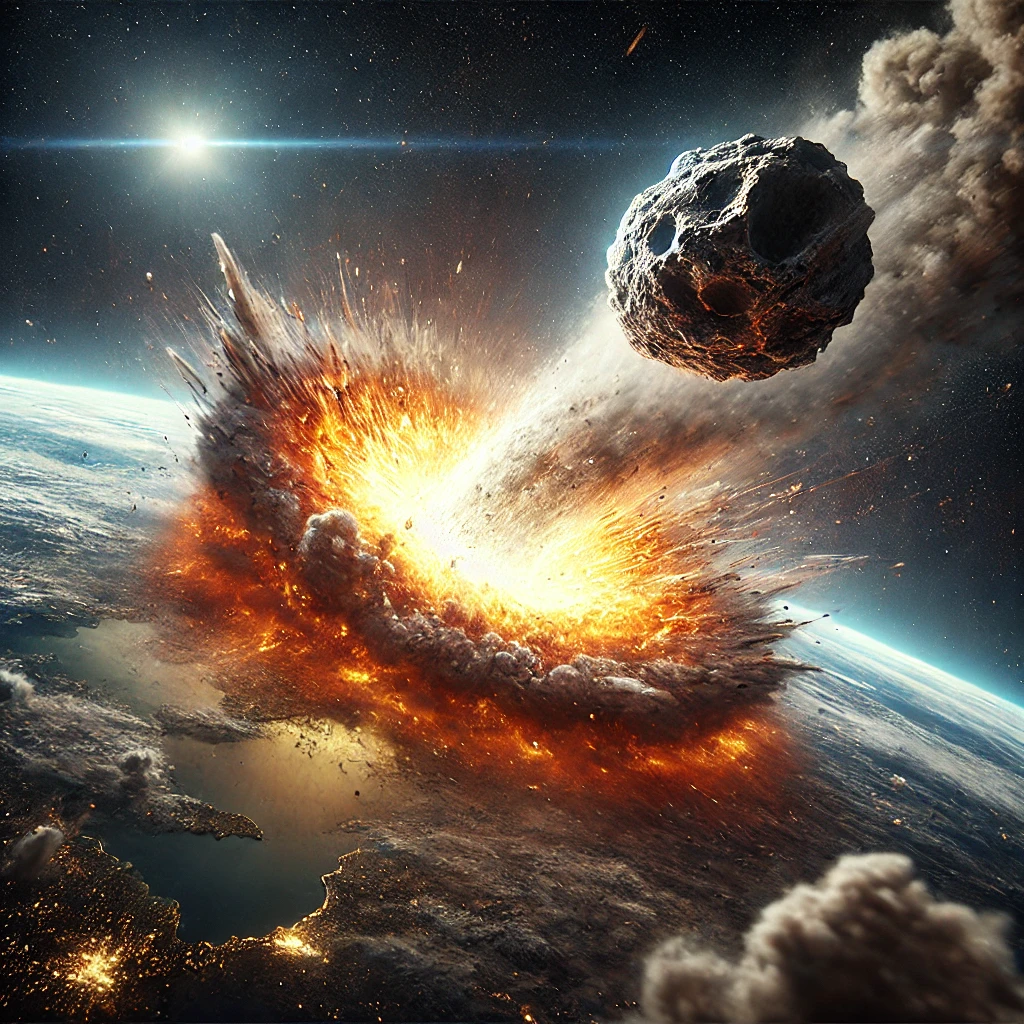
Space agencies are closely monitoring a newly discovered asteroid that has a slight possibility of colliding with Earth. The asteroid, named 2024 YR4, has been given a 1.2% probability of striking our planet on December 22, 2032, according to findings by the European Space Agency (ESA) and NASA.
However, this also means that the space rock has a 98.8% chance of missing Earth completely, as stated by experts. Scientists are continuing to track the asteroid to refine their calculations and determine if there is any real threat.
The asteroid is estimated to be between 40 and 100 meters (131–328 feet) in diameter, making it comparable in size to a large building. According to the ESA, asteroids of this magnitude typically impact Earth every few thousand years, and their effects can be highly destructive to local regions.
Dr. Paul Chodas, the director of NASA’s Center for Near Earth Object Studies (CNEOS) at Jet Propulsion Laboratory, noted that the asteroid’s precise size remains uncertain due to its recent discovery. Astronomers are currently using multiple telescopes to measure its actual dimensions.
“If the asteroid turns out to be on the larger side of its estimated range, its impact could cause devastating damage up to 50 kilometers (31 miles) from the impact site,” Chodas explained. “However, the likelihood of impact is still very low. The reason for the potential damage is the asteroid’s extreme speed—it would enter Earth’s atmosphere at approximately 17 kilometers per second (38,028 miles per hour).”
Newsdom Knowledge!
Asteroid Impact Probability and Response Measures
The probability of an asteroid collision is evaluated using the Torino Impact Hazard Scale, which ranks risks from 0 to 10. Higher numbers indicate a greater likelihood of impact and more severe consequences.
📌 Key Torino Scale Levels:
- 0: No risk of collision
- 1–4: Requires further observation but poses no immediate danger
- 5–7: Possible collision with potential regional damage
- 8–10: Impact is certain, with severe regional or global consequences
Currently, 2024 YR4 is classified as a Level 3 asteroid, meaning astronomers are closely tracking it, but there is no immediate threat.
Strategies to Prevent Asteroid Collisions
Scientists are researching various methods to prevent asteroid impacts, with orbit deflection being the most promising solution.
In 2022, NASA’s DART mission (Double Asteroid Redirection Test) successfully demonstrated that an artificial impact could alter an asteroid’s trajectory. Other proposed methods include the gravity tractor technique and nuclear explosion-based deflection.
Ultimately, continuous space monitoring and rapid response strategies are the key to preventing potential asteroid collisions.
Newsdom Vocabulary!
✅ Asteroid – A small rocky or metallic body that orbits the Sun, typically found in the asteroid belt between Mars and Jupiter.
Sentence: Scientists are tracking an asteroid that may pass close to Earth next year.
✅ Probability – The likelihood or chance of an event occurring.
Sentence: The probability of an asteroid impact is very low, but scientists are monitoring it closely.
✅ Impact – The forceful collision of one object with another; the effect or influence of an event.
Sentence: The asteroid impact could cause significant damage to the surrounding area.
✅ Diameter – The length of a straight line passing through the center of a circle or sphere.
Sentence: The diameter of the asteroid is estimated to be about 100 meters.
✅ Observations – The act of watching, studying, or recording something to gain information.
Sentence: Scientists are using telescopes for further observations of the asteroid.
✅ Magnitude – The size, extent, or importance of something, often used to measure earthquakes, brightness of stars, or explosions.
Sentence: The magnitude of the explosion would depend on the asteroid’s size.
✅ Deflection – The act of changing the direction of an object, often used in physics and space studies.
Sentence: NASA tested an asteroid deflection method using a spacecraft collision.
✅ Velocity – The speed of something in a given direction.
Sentence: The asteroid’s velocity as it enters the atmosphere is incredibly high.
✅ Trajectory – The path that an object follows as it moves through space.
Sentence: The asteroid’s trajectory will be monitored to assess any impact risk.
✅ Collision – The event of two objects striking each other with force.
Sentence: A collision with Earth is unlikely, but scientists are not ruling it out.
Newsdom Insights
The Fragility and Resilience of Life on Earth
Asteroid 2024 YR4 serves as a reminder that Earth is not immune to cosmic events, reinforcing the importance of preparedness and resilience. Throughout history, asteroid impacts—such as the one that led to the extinction of the dinosaurs—have drastically shaped life on our planet. While the probability of such an event is low, the potential consequences are severe.
This concept extends to personal and societal resilience. Just as scientists prepare for rare but catastrophic events, individuals and communities must build resilience against unexpected challenges—whether economic recessions, natural disasters, or personal hardships. Developing emergency plans, financial safety nets, and mental resilience ensures that when crises occur, we are equipped to handle them.
Lesson: Life is unpredictable, but building resilience and preparedness allows us to withstand even the most unexpected challenges.




 The Newsdom
Leave a comment